Extending charity, one ticket at a time

Knights of Clumbus charities raffle drum, Toronto, May 19, 2013

Charities raffle drum, Toronto, May 19, 2013

You may have seen us in shopping malls and other public locations, selling tickets for the Knights of Columbus charities raffle. You know the scene: one or two people at a table greeting you as you approach, offering a $2 ticket or 3 for $5, filling in your contact information, wishing you luck and thanking you for your purchase.

What you may not know is how much work goes into administering the raffle and how much good the proceeds accomplish. At the local level, our work begins in late October when the tickets arrive. From then until late April, we have crews of volunteers scheduled in 3-hour or 4-hour shifts, offering tickets to the public. Other volunteers account for the tickets and the money, reviewing each day’s sales and submitting the proceeds to our council’s financial secretary and treasurer. The final accounting is carried out in mid-May and the tickets are turned in at the Knights of Columbus annual convention the day before the draw takes place. This year, the draw was held on May 19; the list of winners is published on the Ontario Knights of Columbus website.

Member of the Knights of Columbus selling raffle tickets at a pancake breakfast

Ray, selling raffle tickets at a pancake breakfast

At the annual convention, representatives of some of the charities we sponsor speak to the delegates about the impact of our charitable giving. Margaret Wills of the Arthritis Society reported that with the money we provided last year, the Society launched a chronic pain management program for children; they also supplied children with ergonomically-designed backpacks filled with information and tools for those recently diagnosed with arthritis. Taylor Redmond, a young athlete from Guelph, spoke eloquently about what Special Olympics has meant to him. A competitor in basketball, track and swimming, Taylor believes he can do anything the rest of us can do but he knows that he needs help and patience. He thanked the Knights in Guelph for helping him along his entire athletic career. There weren’t many dry eyes in the room when he finished speaking.

Our volunteers are taking a break over the summer. We’ll be back in the fall, looking to raise much-needed money for charities that make a difference in our community. When you see one of us, drop by to say hello and, if you can, pick up a few tickets. Your smiles keeps the volunteers coming back and your dollars help in many ways across the province.

Turn on the Twitter firehose

If you want to see what a digital mob looks like, try following a Twitter hash tag as an emotional event occurs.

Tweetdeck - image of tweets

Tweetdeck – image of tweets two days after the events in this story

This week, I followed the hash tag #gosnell when word broke that the jury was about to return a verdict in a sensational trial after several days of deliberations. Kermit Gosnell, a doctor in Philadelphia who had operated an abortion clinic accurately described as a house of horrors, was accused of brutally killing babies who had been delivered alive. The jury found him guilty on multiple charges; a hasty plea deal resulted in consecutive life sentences.

The damburst of tweets began immediately after the announcement that the jury had reached a verdict. The tweets appeared and ran down the timeline so quickly I could barely make out the words. In the hour that passed before the verdict became known, the flow of tweets accelerated as comments incited others to comment, in a cascading effect. Given the nature of the accusations and the disgusting details that had been made public during the trial, it’s no surprise that many of the comments were harsh in the extreme, demanding retribution. As soon as one reporter announced a summary of the verdict—guilty on three first degree murder charges—the detail was echoed in thousands of tweets per minute.

I also followed the hash tag #bosma when it was announced that an arrest had been made in the case of the disappearance of Tim Bosma, a young Canadian man who had fallen among thieves. The flow, proportionally slower than the Gosnell flow, still ran at a fast pace for hours.

What was the experience like?

  • At the peak of the flow, my eye could make out only random words from a message as it slipped down the page; because of the density of messages, the random words built of coherent picture of the prevailing sentiment.
  • The topic could shift and reorient like a flock of swallows; as soon as a fact or rumour was reported, the follow-up tweets absorbed and built on it.
  • Twitter was ahead of the main news outlets by several minutes; presumably,  the process of verifying information and composing readable dispatches accounts for the difference in timing.
  • The tweets on these occasions were expressions of emotions, not eye-witness accounts of unfolding events, so they contributed very little to the understanding of the events.

In both cases, Twitter’s main strength—immediacy—was negated by the sheer volume of tweets. So many people commented that no one could read the messages as they sped by; it would take a software solution to count and categorize the sentiments and expose the various threads of argument and commentary.

Given the nature of the events being commented upon, it shouldn’t be surprising that the nasty comments demanding retribution were the most prominent. Comparatively few spoke of mercy for the accused. The flow of tweets has been likened to a fire hose; in this case, it would have taken a fire hose to wash away to stain of anger and nastiness that spread with the succession of comments.

Appreciating the new translation of the Roman Missal

For eighteen months, the Catholic Church has used a new translation of the Roman Missal, a translation meant to be used not only in North America but Great Britain, Ireland, South Africa, Singapore, China and other countries whose idiomatic English differs greatly from our own. In the run-up to its adoption, parishes conducted workshops and distributed explanatory texts to prepare us for the dramatic change in the prayers we had become accustomed to.

At a workshop in our parish, opinion was clearly divided. Some argued that the return to an elevated language was a mistake, a turning back from the advances of the 1960’s and 1970’s. Others welcomed the changes in general but objected to particular words or phrases.

At the first Mass with the new translation, my doubts were erased. The words soared. Layers of meaning were exposed as clause built upon clause. And long-forgotten phrases, set aside so many years ago, came back with an unexpected freshness. I wondered why I was so taken with the revised language but had no clear answer until I acquired The Beauty of the Word by Anthony Esolen. His work examines the principles of translation, the oratorical strategy and many of the scriptural references.

Cover page of The Beauty of the Word, published by Magnificat

Cover page of The Beauty of the Word, published by Magnificat

I found the key  to understanding my fondness for this translation in Esolen’s explanation that the sentence structure was designed with the demands of oratory in mind. Oratory requires “repetition of key words, parallel structures in grammar and sense, balance of idea with idea and image with image, and – something that people unused to oral poetry do not suspect – a minimum of full stops that interrupt the flow of declamation and meaning.” He cites the examples of Homer – who composed with his mind, voice and ear but not his hand or eye – and Martin Luther King, whose long sentences exhibited the balance and repetition familiar from the writings of Jeremiah and Isaiah. In an arresting image, Esolen describes a series of four simple declarative sentences as “disconnected boxcars bumping into each other on a track.” The sense of the progression is most easily acquired when the sentences are connected, like boxcars pulled by the same engine.

Esolen’s explanation makes sense to me because it fits with my recent experience. In the past few years, I have memorized passages of 800 and 1400 words, to be recited – without visual aids of any sort – in Knights of Columbus ceremonies. With no background in drama, I was expecting the process to be an ordeal. Instead, memorizing and delivering the long passages has been a pleasant experience. The passages employ parallelism, imagery and repetition to great effect, making it easy for the speaker to memorize and the listener to follow.

In my view, the translation has been a great success. I recommend Esolen’s book to anyone who wishes to study the translation more closely.

Mothers Day tribute from the Knights

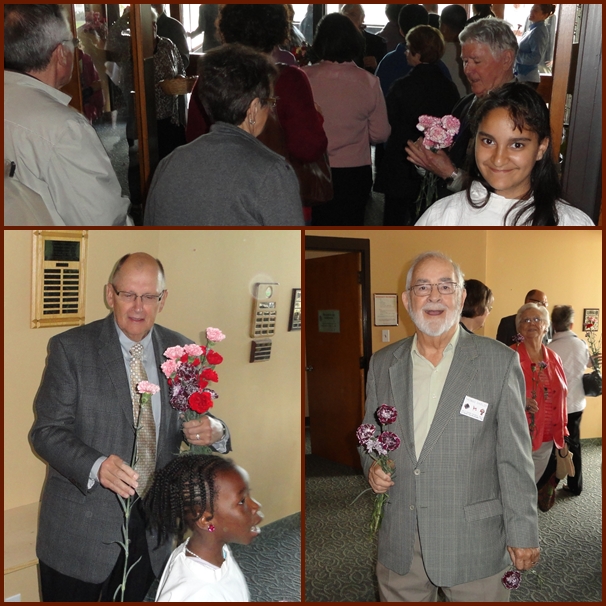
This weekend, after all Masses, our Council distributed flowers to the mothers in the congregation. It’s a symbolic gesture that reminds Knights not only to honour the mothers among us but also that our order was created as a fraternal benefits organization charged with the care of our deceased members’ widows and children.

Knights distribute flowers for Mothers at Holy Cross Parish

Members of Holy Cross Council distribute flowers for mothers at the entrance to the church.

Spring cleaning the capital

Holy Cross Council took part in the semi-annual Cleaning the Capital campaign again this spring. Saturday, May 4, was a perfect day for the event: a clear sky, no wind, dry ground and temperatures in the high teens in the morning. Twenty-one Knights and family members picked up litter along the Airport Parkway between Walkley Road and Hunt Club Road. As usual, the spring cleanup was more demanding than the fall session; Canadians seem to throw out more litter during the winter.

Holy Cross Council team prepares to pick up litter along the Airport Parkway

Holy Cross Council team prepares to pick up litter along the Airport Parkway

Members of the team relax over coffee and donuts.

Members of the team relax over coffee and donuts.

Gatsby, a parable for our times

They were careless people, Tom and Daisy—they smashed up things and creatures and then retreated back into their money or their vast carelessness, or whatever it was that kept them together, and let other people clean up the mess they had made ….

Jay Gatsby is in the news again. Commerce and culture have presented us a new movie version with tie-ins to Gatsby-themed fashions and a rush of Gatsby parties. Yet again, we float over the surface, envying the glamorous trappings of the Jazz Age with barely a thought for the corrupt and unstable foundation that supported it. Not so Scott Fitzgerald. Out of his early encounter with success, he created a story that revealed the corruption of his times and exposes the corruption of our own.

The Great Gatsby - spine of the copy I've read since 1974.

The Great Gatsby – spine of the book-club copy I’ve read since 1974.

The background details easily could be transposed into the present. Gatsby’s parties were notorious on a local scale; today, gossip magazine, websites and television reporting would simplify amplify the gossip to the farthest ends of the earth. Fixing the 1919 World’s Series was a precursor to the point-shaving, electronic eavesdropping and performance-enhancing drugs that have marred sports in recent years. Stock manipulation by Tom Buchanan’s set—with their polo ponies and lavish lifestyles—are outstripped by the misdeeds of our financial barons and frauds like Bernie Madoff. Bootlegging has given way to the drug trade.

The restlessness at the core of the characters’ inner lives is entirely to be expected. Wealth, pleasure, power and honor—the false gods of all times and places—lead them from the bright lights to the gloom of their self-made purgatory. Gatsby accumulates wealth but finds no satisfaction in his heaps of imported shirts, his mansion, his float-plane or his flashy car. In the midst of his gigantic parties, Gatsby stands aloof, dreaming of regaining his lost love and rewriting their past. Tom Buchanan carries on an unsatisfactory affair with Myrtle Wilson, out of boredom and a sense of entitlement; in a drunken argument, he breaks Myrtle’s nose when she taunts him with his wife’s name. Daisy, she of the breathy voice and the object of Gatsby’s desire, is generally too bored to rise from her couch.

In the midst of the drinking, double-dealing, partying and plotting, reality breaks in. An agitated Daisy, driving Gatsby back from a disastrous party, accidentally kills Myrtle Wilson and flees the scene. Gatsby hides the car in his garage and prepares to take the blame for the accident. He watches Daisy’s house through the night, fearing that Tom will beat her. But there had been nothing to fear: Tom and Daisy had reconciled.

Daisy and Tom were sitting opposite each other at the kitchen table, with a plate of cold dried chicken between them, and two bottles of ale. He was talking intently across the table at her, and in his earnestness his hand had fallen upon and covered her own. Once in a while she looked up at him and nodded in agreement.

They weren’t happy, and neither of them had touched the chicken or the ale—and yet they weren’t unhappy either. There was an unmistakable air of natural intimacy about the picture, and anybody would have said that they were conspiring together.

The following day, Myrtle’s husband kills Gatsby, acting on hints from Tom that Gatsby had been driving.

The Great Gatsby, a cautionary tale, reminds us of how easily the well-lit path detours into darkness. Betrayal, misplaced loyalty, wasted lives abound. And not even the narrator, who maintains his scruples to a degree, escapes untarnished: he shields the hit-and-run driver from the law and makes himself party to the injustice he implicitly condemns.

The question that Gatsby poses is not one of fashion or fad or even literary merit; it is the hard question, directed to the discerning heart during the Baptismal rite, “Do you reject the glamor of evil?”